

Run a small business in India today and you already know the pressure. Costs keep climbing. Customers expect instant replies at 11 pm. Competitors — some funded, some just faster — are chipping away at your margins. And your team is stretched thin, doing the same repetitive tasks every single day: replying to the same WhatsApp questions, chasing the same leads, typing the same data into the same spreadsheet.
This is exactly why AI business automation for small enterprises in India has moved from “nice to have” to “how did we survive without this.”
You don’t need a 200-person tech team or a Silicon Valley budget to use AI. What you need is the right strategy, the right processes, and the best AI business automation services built for how Indian SMEs actually operate — with WhatsApp, regional languages, tight budgets, and owners who wear five hats before lunch.
This guide walks through everything: what AI automation actually means, which processes you should automate first, what it costs in India, how to pick a provider, and the mistakes that quietly waste most companies’ automation budgets.
What is AI Business Automation?
People throw around “AI,” “automation,” and “AI agents” like they’re the same thing. They’re not, and the difference matters when you’re spending money.
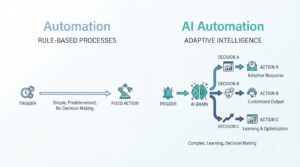
Automation is old news. It’s rule-based. If X happens, do Y. A simple example: if an order is placed, send a confirmation email. No thinking involved — just a trigger and a fixed response.
AI is different. It’s software that can understand language, recognise patterns, and make judgment calls the way a person would — reading a customer message and figuring out what they actually want, even if they type it badly or in Hinglish.
AI automation combines the two. It’s automation that uses AI to think, decide, and act — not just follow a fixed script.
Here’s a simple way to see the difference. A basic chatbot might only reply “Please visit our website” no matter what you type. An AI agent, on the other hand, can read “bhai order kab aayega,” understand you’re asking about delivery status, pull your order number from the CRM, and reply with the actual delivery date — in the same casual tone you used.
That’s the shift: from rigid scripts to intelligent workflows that adapt to real conversations and real business data.
A quick example from a Pune-based furniture retailer: their old system sent one generic WhatsApp reply to every query. After moving to an AI-driven workflow, the same channel now answers product questions, checks stock across two warehouses, and books a showroom visit — without a human touching it, unless the customer specifically asks for one.

Why Small Enterprises in India Need AI Automation
Big companies had automation years before it became affordable for smaller businesses. That gap has closed. Here’s why it matters right now, specifically for Indian SMEs.
Cost savings. Hiring and training staff for repetitive roles — data entry, basic support, follow-up calls — is expensive and has high attrition. AI handles the repetitive 80% so your people can focus on the harder 20%.
Faster operations. A lead who messages you on Instagram at 9 pm doesn’t want to wait until 10 am the next day. AI responds immediately, any hour, any day.
Better customer support. Most customer questions are the same handful of questions, over and over — pricing, delivery timelines, refund policy, product specs. AI handles these instantly and routes only the complex cases to your team.
Stronger lead generation. Instead of leads going cold in a spreadsheet, AI can qualify them the moment they come in and hand your sales team only the ones worth calling.
Higher employee productivity. When your team isn’t manually copying data between apps, they spend that time on selling, building relationships, and solving actual problems.
Less manual, repetitive work. Fewer typos, fewer missed follow-ups, fewer things falling through the cracks.
A real competitive edge. When your competitor still makes customers wait two days for a quote and you reply in two minutes, that difference wins business.
Take a small real estate brokerage in Bengaluru. Before automation, an agent manually followed up with every lead from property portals — often days later, by which point the buyer had already spoken to three other agents. After adding an AI-driven lead qualification workflow, every enquiry gets an instant WhatsApp response, gets scored automatically, and the agent only calls the leads that are genuinely ready to buy.
Top Business Processes That Can Be Automated


Not every process deserves automation on day one. Below are the processes Indian SMEs typically get the most value from, in roughly the order most businesses should tackle them.
Customer Support
Problem: The same 10–15 questions repeated hundreds of times a week, tying up staff who could be doing higher-value work. AI solution: An AI chatbot or voice agent trained on your FAQs, product catalogue, and policies. Benefit: Instant answers around the clock, fewer support tickets escalated, happier customers.
Sales Conversations
Problem: Sales reps spend hours on early-stage conversations that go nowhere. AI solution: AI sales assistants that handle initial questions, share pricing, and only pass “ready to buy” conversations to humans. Benefit: Reps spend time closing, not qualifying.
Lead Qualification
Problem: Every lead gets treated equally, even the ones who were “just browsing.” AI solution: AI scores leads based on intent, budget signals, and engagement. Benefit: Sales effort goes where it actually converts.
Appointment Booking
Problem: Endless back-and-forth on “what time works for you” over calls and messages. AI solution: AI agents that check calendar availability and confirm bookings automatically. Benefit: Fewer no-shows, less admin time.
WhatsApp Automation
Problem: WhatsApp is where most Indian customers actually want to talk to you — but it’s manual and easy to fall behind on. AI solution: AI-powered WhatsApp automation for FAQs, order tracking, catalogue browsing, and booking. Benefit: Your busiest channel finally scales without hiring more people.
CRM Updates


Problem: Sales and support teams forget to log calls, notes, or status changes. AI solution: AI automatically updates CRM records from calls, emails, and chats. Benefit: A CRM that’s actually accurate — and useful for decisions.
Email Follow-Ups
Problem: Leads go cold because nobody remembered to follow up on day 3, 7, and 14. AI solution: AI-driven email sequences, personalised to each contact’s stage. Benefit: Consistent follow-up without manual tracking.
Invoice Generation
Problem: Manually creating invoices for every order eats hours every week. AI solution: Automated invoice generation triggered directly from orders or CRM data. Benefit: Faster billing, fewer errors, quicker payments.
HR Onboarding
Problem: New hires wait days for documents, access, and orientation info. AI solution: AI-guided onboarding flows that handle paperwork, FAQs, and scheduling. Benefit: New employees are productive from week one, not week three.
Recruitment Screening
Problem: HR teams manually sort through hundreds of resumes for every opening. AI solution: AI shortlists candidates based on role requirements. Benefit: Hours of manual screening reduced to minutes.
Marketing Automation
Problem: Campaigns run without personalisation because there’s no time to segment audiences manually. AI solution: AI-driven segmentation and messaging based on customer behaviour. Benefit: Higher engagement without extra headcount.
Inventory Management
Problem: Stockouts and overstocking because tracking is manual or delayed. AI solution: AI-based demand forecasting and stock alerts. Benefit: Fewer lost sales, less capital tied up in excess stock.
Internal Knowledge Assistant
Problem: Employees waste time searching for policies, SOPs, or past decisions. AI solution: An internal AI assistant trained on your company documents. Benefit: Instant, accurate answers — no more “let me check and get back to you.”
Document Processing
Problem: Manually entering data from invoices, forms, or contracts. AI solution: AI extracts and structures data from documents automatically. Benefit: Fewer manual errors, faster processing.
Analytics
Problem: Business owners make decisions on gut feel because reports take too long to prepare. AI solution: AI-generated dashboards and insights from your existing data. Benefit: Faster, more confident decisions.
Reporting
Problem: Weekly and monthly reports eat up hours that could go into actual analysis. AI solution: Automated report generation, delivered on schedule. Benefit: Time saved, consistent reporting quality.

Best AI Business Automation Services
Here’s a closer look at the specific services that make up most AI automation projects for Indian SMEs — what each one does, who benefits, and what to realistically expect.
| Service | What It Does | Who Needs It | Typical Implementation Time | Expected ROI |
|---|---|---|---|---|
| AI Chatbots | Answers customer questions on website/app instantly | E-commerce, retail, service businesses | 1–3 weeks | Reduced support load, faster response times |
| AI Voice Agents | Handles inbound/outbound calls for support or sales | Clinics, real estate, finance | 3–6 weeks | Fewer missed calls, lower staffing cost |
| WhatsApp AI | Automates conversations on WhatsApp Business | Almost every Indian SME | 2–4 weeks | Higher lead response rate, more conversions |
| AI Email Automation | Sends personalised, triggered email sequences | B2B, agencies, SaaS, education | 1–2 weeks | Better follow-up consistency |
| CRM Automation | Keeps CRM data accurate without manual entry | Sales-driven businesses | 2–4 weeks | Cleaner pipeline, better forecasting |
| AI Lead Generation | Identifies and engages potential customers | Agencies, real estate, B2B | 3–6 weeks | More qualified leads per month |
| AI Sales Assistants | Supports reps with info, follow-ups, and scheduling | Sales teams of any size | 2–5 weeks | Shorter sales cycles |
| AI Customer Service | Manages support tickets and FAQs across channels | Retail, e-commerce, services | 2–4 weeks | Lower cost per support ticket |
| AI Workflow Automation | Connects apps and automates multi-step processes | Operations-heavy businesses | 3–8 weeks | Significant time savings across teams |
| AI Document Automation | Extracts and processes data from documents | Finance, legal, manufacturing | 2–5 weeks | Reduced manual data entry hours |
For every service, the honest answer on ROI and timeline is: it depends on your process complexity and how ready your data is. A single WhatsApp FAQ bot can go live in under two weeks. A multi-department workflow automation project touching your CRM, inventory, and finance systems will take longer and needs more planning.
Industries That Benefit Most
Manufacturing: Automating inventory tracking, supplier communication, and quality reporting reduces downtime and manual paperwork on the shop floor.
Healthcare: Clinics use AI for appointment booking, patient reminders, and answering common queries — freeing front-desk staff for in-person patients.
Education: Institutes automate admissions enquiries, fee reminders, and student support, especially during peak admission season.
Real Estate: Brokerages automate lead qualification and property enquiry follow-ups, since speed of response directly affects conversions.
Retail: Stores automate WhatsApp order updates, stock queries, and post-sale support.


E-commerce: Online sellers automate order tracking, returns, and customer support across multiple marketplaces.
Hospitality: Hotels and resorts automate booking confirmations, guest queries, and review requests.
Finance: NBFCs and advisory firms automate document collection, KYC follow-ups, and routine client queries.
Professional Services: Consultants, agencies, and CA firms automate client onboarding, scheduling, and status updates.
Construction: Firms automate vendor communication, project status updates, and document management across sites.
Benefits of AI Automation

Time savings. Tasks that used to take hours — data entry, follow-ups, report generation — happen in minutes or automatically, in the background.
Revenue growth. Faster response times and consistent follow-up directly translate into more conversions from the same number of leads.
Employee efficiency. Your team spends time on judgment-based work, not repetitive admin.
Customer satisfaction. Faster answers and fewer dropped queries build trust, especially for customers used to slow responses from smaller businesses.
Scalability. You can handle 10x the enquiries without hiring 10x the staff.
Lower operational costs. Less time spent on manual work means lower cost per transaction, per lead, and per support ticket.
24/7 availability. Customers in different time zones — or just working late — get answered instantly, not the next morning.
Faster decision-making. With automated reporting and dashboards, owners see what’s happening in the business without waiting for a weekly meeting.
Independent research from firms like McKinsey and Gartner has repeatedly pointed to automation and AI adoption as a meaningful driver of productivity gains across industries — though the exact impact for any single business depends heavily on which processes are automated and how well the rollout is executed. Treat industry-wide statistics as directional, not a guarantee for your specific business.
How to Choose an AI Automation Company in India


Not every “AI automation agency” is equipped to actually deliver. Use this checklist before signing anything.
- Experience — Have they actually delivered projects in your industry, or is this their first attempt?
- Custom solutions — Do they build for your specific workflows, or just resell the same template to everyone?
- Security — How is your customer and business data stored, encrypted, and accessed?
- Support — What happens after launch? Is there ongoing support, or are you on your own?
- Pricing transparency — Are costs clearly explained, with no hidden fees for “extra” features?
- Scalability — Can the solution grow as your business grows, without a full rebuild?
- Technology stack — Do they use reliable, well-supported AI models and tools, not experimental ones?
- Integration capability — Can it actually connect with your existing CRM, WhatsApp Business, website, and other tools?
- Case studies — Can they show real, verifiable results from past clients?
- Reviews and references — Can you talk to an existing client before signing?
If a provider can’t answer these clearly, that’s a signal worth paying attention to.
Why Choose Artificial Intelligence Agent
At [Artificial Intelligence Agent], the focus isn’t selling AI for the sake of AI — it’s solving the specific operational problems that slow small businesses down.


The approach centres on:
- Custom AI agents built around your actual workflows, not generic templates
- Workflow automation connecting the tools you already use
- AI consulting to identify which processes are worth automating first — and which aren’t
- Chatbots and voice AI trained on your business, your tone, your policies
- CRM automation that keeps your sales data accurate without manual entry
- WhatsApp automation built for how Indian customers actually communicate
- Business process automation across support, sales, HR, and operations
- Integration with your existing software stack, rather than forcing you to switch systems
- Ongoing optimisation and support, because automation isn’t a one-time install — it needs tuning as your business changes
Explore [AI Chatbot Services] and [AI Consulting] to see how this applies to your specific business, or head to [Contact Us] to start a conversation.
Pricing of AI Business Automation in India
Pricing for AI automation in India varies widely because “AI automation” covers everything from a simple FAQ chatbot to a multi-department workflow overhaul. As a general guide:
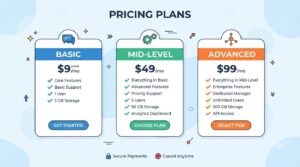

- Basic AI chatbot / WhatsApp automation: A modest one-time setup cost plus a smaller monthly fee, suitable for single-channel FAQ and order-status automation.
- Mid-level automation (CRM automation, lead qualification, email sequences): A moderate setup investment with ongoing monthly costs tied to usage volume.
- Advanced, multi-process automation (voice agents, cross-department workflows, custom AI agents with deep integrations): A higher upfront investment reflecting the complexity of integration, testing, and customisation, with monthly costs scaling with usage.
The real cost driver isn’t the “AI” part — it’s complexity, number of integrations, data readiness, and ongoing usage volume. A business automating one WhatsApp flow will pay far less than one automating five interconnected departments. Always ask for a clear breakdown of one-time setup costs versus recurring monthly costs before committing.
Frequently Asked Questions
What is AI business automation? It’s the use of AI-powered tools and agents to handle business tasks — from customer support to sales follow-ups — that would otherwise require manual, repetitive human effort.
How much does AI automation cost in India? Costs vary based on complexity, ranging from modest monthly fees for a basic chatbot to a larger investment for multi-process, fully integrated automation.
Can small businesses afford AI? Yes. Most AI automation services are built with modular pricing, so small businesses can start with one process — like WhatsApp automation — and expand as they see results.
Which industries benefit the most? Retail, e-commerce, healthcare, real estate, and professional services see some of the fastest returns, mainly because they deal with high volumes of repetitive customer interactions.
How long does implementation take? A single chatbot or WhatsApp automation can go live in two to four weeks. Larger, multi-department workflows can take a couple of months, depending on integration complexity.
Can AI integrate with my CRM? In most cases, yes — provided your CRM has an API or supports standard integrations. This should always be confirmed before you sign a contract.
Does AI replace employees? No, not for most small businesses. It removes repetitive tasks so employees can focus on higher-value work like relationship-building, strategy, and complex problem-solving.
What is an AI agent? An AI agent is software that can understand a request, make a decision, and take an action — like answering a query, updating a record, or booking an appointment — without needing a human to handle each step.
Is AI automation secure? Security depends heavily on the provider and how they handle data storage, encryption, and access controls. Always ask directly about data security practices before starting.
How do I get started? Start small. Pick one repetitive process — customer support, lead follow-up, or appointment booking — automate it, measure the results, and expand from there.
Conclusion
AI business automation isn’t about replacing your team — it’s about giving them room to do the work that actually needs a human. For small enterprises across India, the smartest path isn’t automating everything at once. It’s picking one high-friction process, whether that’s WhatsApp support, lead follow-up, or invoice generation, automating it well, measuring the results, and then scaling to the next process.
The businesses that win with AI aren’t necessarily the ones with the biggest budgets — they’re the ones that start, measure honestly, and keep improving.
If you’re ready to see where AI automation fits into your business, [Contact Us] for a free consultation and AI readiness assessment. We’ll walk through your current processes and show you exactly where automation would make the biggest difference — no pressure, no jargon.